

The workability for planned operations is determined to optimize fleet usage and enable educated planning.
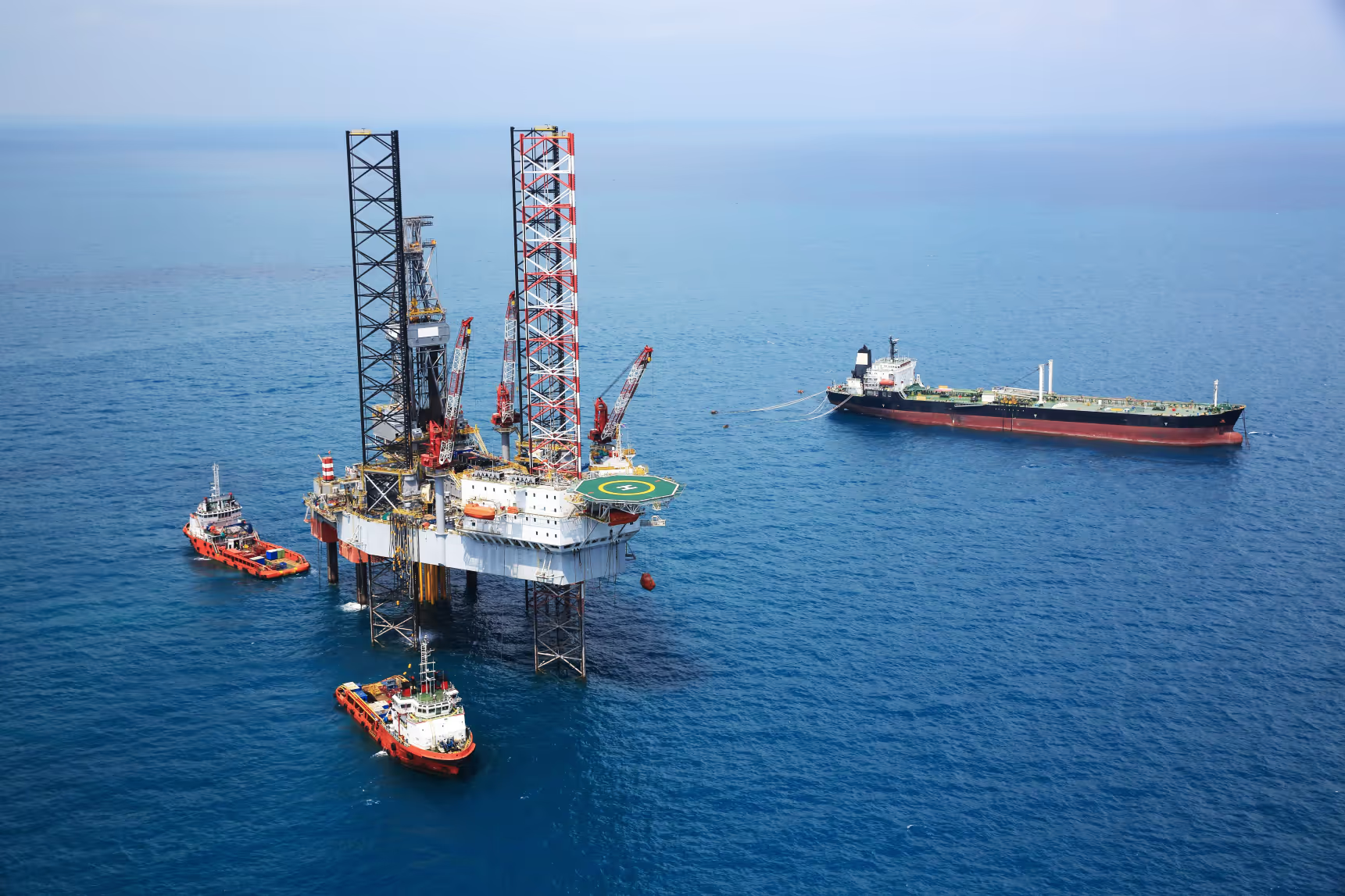


A Site-Specific Assessment (SSA) is performed to assess the suitability of a jack-up for a specific site. Planned operations and survival are assessed. SSAs are performed strictly in compliance with ISO 19905-1:2023. Additional codes and standards may be applied as well.
The jack-up is checked for the following key items:
SSA reports are created to be of the highest quality, focusing on the following aspects:
SSAs are offered at a short delivery time and include unlimited revisions to accommodate to any changes in the project.
Rack Phase Difference (RPD) is an indication of bending moment in the leg. It is typically observed when jacking the hull out of the water and indicates leg splay or sloped seabed. It may also be observed when jacking the hull down after elevated operations. In this case, a cause for RPD has risen during the elevated operations, e.g. due to sliding or scouring.
The RPD tolerance, often indicated as a fixed number in mm, is in reality dependent upon site-specific conditions. The RPD tolerance of a jack-up undergoing an extreme storm or a heavy lift, for instance, may be significantly smaller the RPD tolerance of a jack-up jacking down in a benign environment.
An RPD tolerance assessment determines the allowable RPD based on general or site-specific conditions. It can be used to determine if any leg components have been exposed to higher-than-allowable stresses.
Monitoring campaigns are performed to increase workability by reducing uncertainties. Desktop engineering analysis may contain large uncertainties about reality, which may lead to (overly) conservative assessments. Monitoring bridges the gap between desktop engineering analysis and reality. Gap-bridging monitoring is used to reduce uncertainties and thereby increase the workability and to expand the operational season or capabilities of a jack-up.
The leanest monitoring campaign consists of applying a motion sensor on-board combined with detailed environmental forecast or hindcast. More detailed campaigns may include measurement of strains, position, waves, wind and current.

What information do I need to provide?
How long does it take?
The SSA report will be delivered within 3 working days after all required information has been provided.